Qwen3-VL-Embedding and Qwen3-VL-Reranker: For the Next Generation of Multimodal Retrieval
In June 2025, we open-sourced the text-oriented Qwen3-Embedding and Qwen3-ReRanker model series, providing best-in-class performance across a variety of downstream tasks, including multilingual text retrieval, clustering, and classification, which have been widely adopted by developers in the community. Today, we are thrilled to announce the release of the Qwen3-VL-Embedding and Qwen3-VL-Reranker series, the newest models in the Qwen family. Built on the recently open-sourced and powerful Qwen3-VL foundation models, these models are specifically engineered for multimodal information retrieval and cross-modal understanding.
Key Features#
-
Multimodal Versatility: Both models seamlessly handle a wide range of inputs—including text, images, screenshots, and video—within a unified framework. They deliver state-of-the-art performance across diverse multimodal tasks such as image-text retrieval, video-text matching, visual question answering (VQA), and multimodal content clustering.
-
Unified Representation Learning (Embedding): By leveraging the Qwen3-VL architecture, the Embedding model generates semantically rich vectors that capture both visual and textual information in a shared space. This facilitates efficient similarity computation and retrieval across different modalities.
-
High-Precision Reranking (Reranker): We also introduce the Qwen3-VL-Reranker series to complement the embedding model. The reranker takes a (query, document) pair as input—where both query and document may contain arbitrary single or mixed modalities—and outputs a precise relevance score. In retrieval pipelines, the two models are typically used in tandem: the embedding model performs efficient initial recall, while the reranker refines results in a subsequent re-ranking stage. This two-stage approach significantly boosts retrieval accuracy.
-
Exceptional Practicality: Inheriting Qwen3-VL’s multilingual capabilities, the series supports over 30 languages, making it ideal for global applications. It is highly practical for real-world scenarios, offering flexible vector dimensions, customizable instructions for specific use cases, and strong performance even with quantized embeddings. These capabilities enable developers to seamlessly integrate both models into existing pipelines, unlocking powerful cross-lingual and cross-modal understanding.

Figure 1: Illustration of the Unified Multimodal Representation Space. Qwen3-VL-Embedding model series represent multi-source data (Text, Image, Visual Document, and Video) into a common manifold.
Model Overview#
Table: Model specifications for the Qwen3-VL-Embedding and Qwen3-VL-Reranker
| Model | Size | Layers | Sequence Length | Embedding Dimension | Quantization Support | MRL Support | Instruction Aware |
|---|---|---|---|---|---|---|---|
| Qwen3-VL-Embedding-2B | 2B | 28 | 32K | 2048 | Yes | Yes | Yes |
| Qwen3-VL-Embedding-8B | 8B | 36 | 32K | 4096 | Yes | Yes | Yes |
| Qwen3-VL-Reranker-2B | 2B | 28 | 32K | - | - | - | Yes |
| Qwen3-VL-Reranker-8B | 8B | 36 | 32K | - | - | - | Yes |
Note: “Quantization Support” indicates the supported quantization formats for the embeddings. “MRL support” denotes whether the embedding model allows user-specified embedding dimension. “Instruction-aware” indicates whether the models support task-specific customization of the input instruction.
Model Architecture#
Similar to the Qwen3-Embedding and Qwen3-ReRanker model series, Qwen3-VL-Embedding employs a dual-tower architecture while Qwen3-VL-Rerank utilizes a single-tower architecture. We have designed a multi-stage training paradigm to fully leverage and unleash the powerful general multimodal semantic understanding capabilities of Qwen3-VL, providing high-quality semantic representations and a precise re-ranking mechanism for complex, large-scale multimodal retrieval tasks.
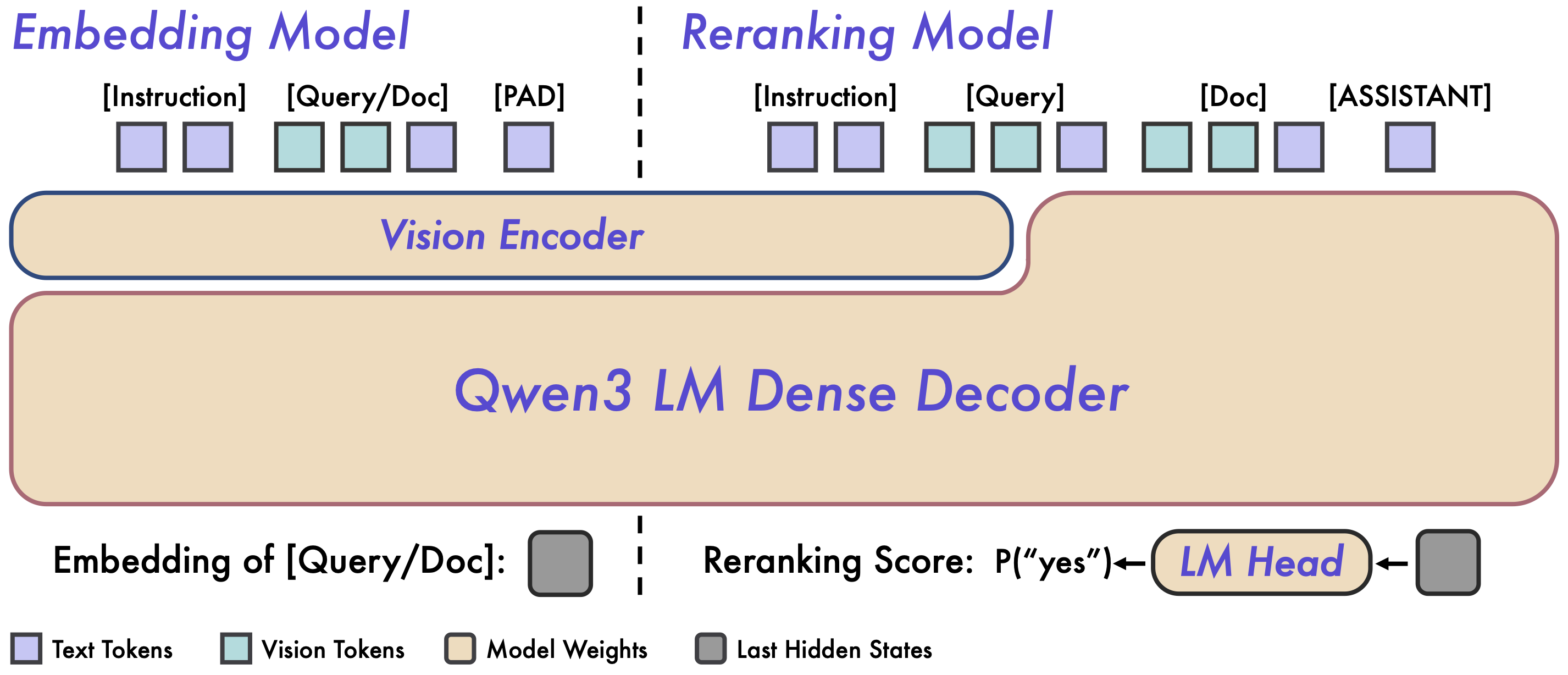
Figure 2: Overview of the Qwen3-VL-Embedding and Qwen3-VL-Reranker architecture. .
The Embedding model receives single-modal or mixed-modal input and maps it into a high-dimensional semantic vector. Specifically, we extract the hidden state vector corresponding to the [EOS] token from the base model’s last layer to serve as the final semantic representation of the input. This method ensures efficient, independent encoding necessary for large-scale retrieval. The Reranking model receives an input pair (Query, Document) and performs joint encoding. It utilizes the Cross-Attention mechanism within the base model to achieve deeper, finer-grained inter-modal interaction and information fusion between the Query and the Document. The model ultimately expresses the relevance score of the input pair by predicting the generation probability of two special tokens (yes and no).
Feature Comparison
| Qwen3-VL-Embedding | Qwen3-VL-Reranker | |
|---|---|---|
| Core Function | Semantic Representation, Embedding Generation | Relevance Scoring, Re-ranking |
| Input | Single modality or mixed modalities (Text, Image, Video, Screenshots) | (Query, Document) pair, where Query and Document can be single- or mixed-modal inputs |
| Mechanism | Independent Encoding, Efficient Retrieval (Dual-Tower) | Deep Inter-Modal Interaction, Precise Alignment (Single-Tower/Cross-Attention) |
| Objective | Semantic Clustering within Vector Space | Output Relevance Score |
Evaluation Results#
Qwen3-VL-Embedding#
We primarily evaluated the Qwen3-VL-Embedding model on MMEB-v2 and MMTEB benchmarks. The Qwen3-VL-Embedding-8B model achieves state-of-the-art results on MMEB-V2, surpassing all previous open-source models and proprietary model services. When breaking down performance across different retrieval modalities, our model consistently achieves SOTA results on image, visual document, and video retrieval subtasks. Meanwhile, on the text-only multilingual MMTEB benchmark, the Qwen3-VL-Embedding model shows a performance gap compared to the text-only Qwen3-Embedding model of comparable size. However, when compared to other similarly sized models on the evaluation leaderboard, it still demonstrates highly competitive performance.

Figure 3: Evaluation results on MMEB-v2 and MMTEB benchmarks .
Qwen3-VL-ReRanker#
We utilize retrieval task datasets from various subtasks of MMEB-v2 and MMTEB retrieval benchmarks. For visual document retrieval, we employ JinaVDR and ViDoRe v3 datasets. Our results demonstrate that all Qwen3-VL-Reranker models consistently outperform the base embedding model and baseline rerankers, with the 8B variant achieving the best performance across most tasks.
| Model | Size | MMEB-v2(Retrieval) - Avg | MMEB-v2(Retrieval) - Image | MMEB-v2(Retrieval) - Video | MMEB-v2(Retrieval) - VisDoc | MMTEB(Retrieval) | JinaVDR | ViDoRe(v3) |
|---|---|---|---|---|---|---|---|---|
| Qwen3-VL-Embedding-2B | 2B | 73.4 | 74.8 | 53.6 | 79.2 | 68.1 | 71.0 | 52.9 |
| jina-reranker-m0 | 2B | - | 68.2 | - | 85.2 | - | 82.2 | 57.8 |
| Qwen3-VL-Reranker-2B | 2B | 75.1 | 73.8 | 52.1 | 83.4 | 70.0 | 80.9 | 60.8 |
| Qwen3-VL-Reranker-8B | 8B | 79.2 | 80.7 | 55.8 | 86.3 | 74.9 | 83.6 | 66.7 |
Usage#
Embedding and reranking models are typically used together in retrieval systems. The embedding model performs initial recall to retrieve a substantial set of candidates, while the reranking model sorts these candidates based on newly computed relevance scores to present the most accurate results for the user query. This two-stage retrieval process leverages the complementary strengths of both models: the efficiency and scalability of the embedding model for broad candidate retrieval, and the precision and fine-grained scoring capability of the reranking model for final ranking. This approach achieves superior retrieval performance compared to using either model alone. Below are basic usage examples.
- Embedding Model Usage Example
# Define a list of query texts
=
# Define a list of document texts and images
=
# Specify the model path
=
# Initialize the Qwen3VLEmbedder model
=
# We recommend enabling flash_attention_2 for better acceleration and memory saving,
# model = Qwen3VLEmbedder(model_name_or_path=model_name_or_path, dtype=torch.float16, attn_implementation="flash_attention_2")
# Combine queries and documents into a single input list
= +
=
# Compute similarity scores between query embeddings and document embeddings
=
# Print out the similarity scores in a list format
# [[0.83203125, 0.74609375, 0.73046875], [0.5390625, 0.373046875, 0.48046875], [0.404296875, 0.326171875, 0.357421875], [0.1298828125, 0.06884765625, 0.10595703125]]
- ReRanking Model Usage Example
# Specify the model path
=
# Initialize the Qwen3VLEmbedder model
=
# We recommend enabling flash_attention_2 for better acceleration and memory saving,
# model = Qwen3VLReranker(model_name_or_path=model_name_or_path, dtype=torch.float16, attn_implementation="flash_attention_2")
# Combine queries and documents into a single input list
=
=
# [0.8408790826797485, 0.6197134852409363, 0.7778129577636719]
For more usage examples, please visit our GitHub repository.
Future work#
The Qwen3-VL-Embedding and Qwen3-VL-Reranker model series represent our initial exploration into unified multimodal representation and retrieval. Compared to text-only embedding and reranking models, multimodal approaches, particularly unified multimodal embedding and reranking systems, still present vast opportunities for exploration in terms of model maturity, usability and application scenario expansion. The open-sourcing of Qwen3-VL-Embedding and Qwen3-VL-Reranker marks a new starting point. We look forward to collaborating with the community to explore and build more general-purpose unified multimodal retrieval capabilities.
Citation#
If you find Qwen3-VL-Embedding and Qwen3-VL-Reranker helpful in your research, please consider citing us 📝 :)