Single vs Multi-Agent System?
The debate on whats the right way to build Agents in the AI community heated up with Cognition's "Don't Build Multi-Agents" and Anthropic's "How we built our multi-agent research system". Despite their opposing titles both are surprisingly aligned. The choice between a single agent and a multi-agent system isn't about ideology, it is about picking the right tool for the right job.
Before we take a closer look, let's establish a simple definition.
AI agent is a system that uses a Large Language Model (LLM) as reasoning engine to decide the control flow of an application.
What Are Single Agents?#
A single-agent system operates as a “single process”. Think of it as one highly-focused worker tackling a task from start to finish. It maintains a continuous thread of thought (memory) and action (tools) to ensure that every step is informed by everything that came before it.

[Credits: Cognition Don’t Build Multi-Agents]
Key characteristics:
- Sequential: Actions are performed one after another. The agent completes step A before moving to step B.
- Unified Contenxt: Maintains a single, continuous history of the entire conversation. Every new step has access to all previous steps, thoughts, and tool outputs.
- Stateful: Decisions made early on directly and fully inform later actions without the need for message passing.
Pros:
- Context Continuity: No information is lost between steps
- Simplicity: Easier to debug, test, and maintain
- Transparency: Clear execution path and decision trail
Cons:
- Sequential Bottlenecks: Slow for tasks where parts could be handled in parallel.
- Context Window Limitations: Eventually exceed the (useful) context window, leading to errors and forgotten details.
- Inefficiency: May waste tokens on repetitive context and are limited to single model capabilities/instructions
What Are Multi-Agent Systems?#
A multi-agent system is structured like a team. It typically involves an “lead agent" that breaks down a goal into smaller subtasks, which it then delegates to multiple "worker" agents that can operate in parallel.
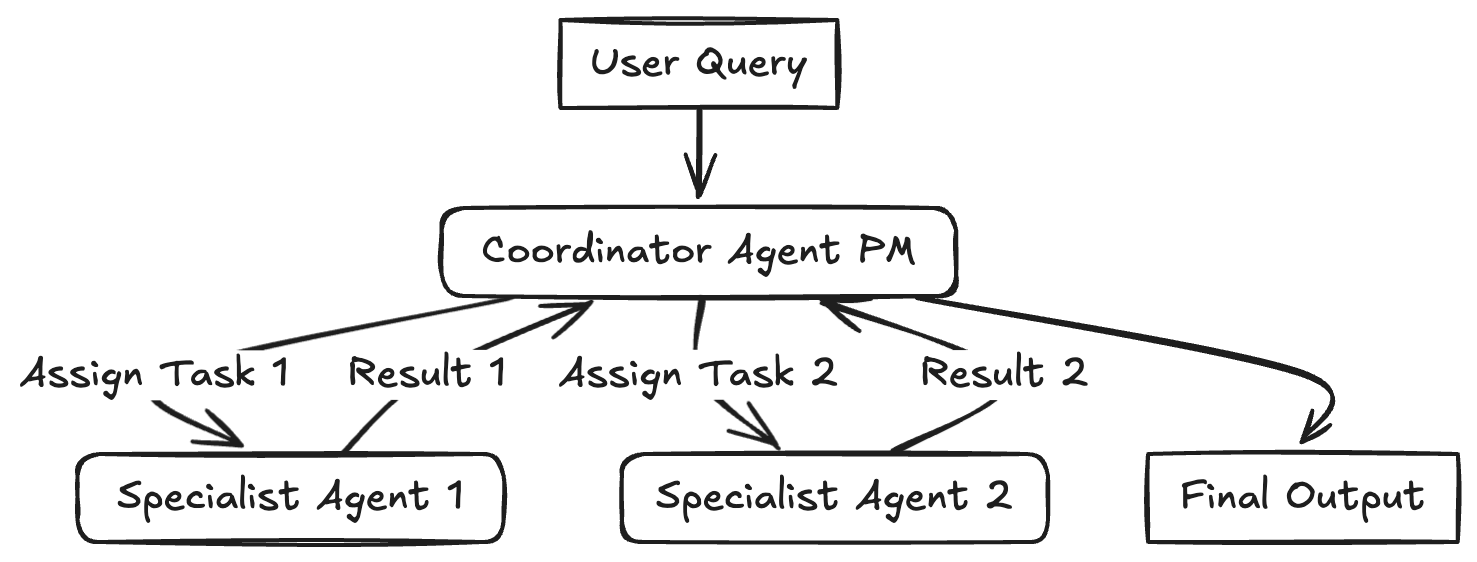
Key characteristics:
- Parallel Execution: Subtasks can be handled simultaneously by multiple agents.
- Delegation: A "lead" agent typically decomposes the main goal, delegates subtasks, and synthesizes the results from the worker agents.
- Distributed Context: Each agent operates with its own context, which is often a subset of the total information.
Pros:
- Parallelization: Can explore multiple paths simultaneously, reducing latency.
- Specialization: Each agent can be optimized and instructed for specific tasks
- Breadth: Can solve complex, multi-faceted problems.
Cons:
- Context: Sharing the right context between agents is hard
- Coordination: Agents may duplicate work or make conflicting decisions
- Cost: Can be more token-intensive. (Anthropic: 15x more tokens compared to a standard chat interaction)
Note: It's worth mentioning other multi-agent pattern, e.g. swarm are not using a "lead" agent. Instead they collaborate in a more peer-to-peer fashion to solve a problem, which has both single agent and multi agent characteristics, e.g. Unified Context, but individual instructions but comes with its on challenges.
Comparison Single Agents vs Multi-Agent Systems#
| Aspect | Single Agent System | Multi-Agent System |
|---|---|---|
| Context Management | Continuous, no loss | Complex sharing required |
| Execution Speed | Sequential | Parallel |
| Token usage | 4x chat tokens | 15x chat tokens |
| Reliability | High, predictable | Lower, emergent behaviors |
| Debugging | Straightforward | Complex, non-deterministic |
| Best For | Sequential, state-dependent tasks ("write" tasks). | Parallelizable, exploratory tasks ("read" tasks). |
| Coordination | None needed | Critical success factor |
| Example Use Case | Refactoring a codebase, writing a detailed document. | Researching a broad market trend, identifying all board members of the S&P 500. |
| Core Strength | Context Continuity & Reliability | Parallelism & Scalability |
| Primary Challenge | Context Window Limits & Sequential Speed | Context Fragmentation & Coordination Complexity |
The Universal Truths of Building Agents#
Despite their opposing common principles apply for building serious Agentic system.
- Context Engineering is everything: Architecting systems that dynamically maintain the right information at the right time for reliable decision-making is the key to success and reliability. This isn't just prompt engineering.
- "Read" vs "Write" Agents: Are important distinction isn't single vs multi-agent. it is whether your task primarily involves reading (research, analysis, information gathering) or writing (code generation, content creation, file editing).
- Read tasks are easier to parallelize and suite multi-agent better
- Write tasks create coordination problems when parallelized, favoring single agents
- Mixed tasks should separate read and write phases architecturally
- Reliable Agents Need Different Tooling: Building reliable agents requires more than a good model. It requires a robust infrastructure for durable execution to survive failures, observability to debug behavior, and evaluation to measure what actually matters.
- Economic Viability and Model Improvements: Models themselves are improving at an incredible rate. Don't over-engineer a solution for today that a much simpler can solve for you tomorrow.
Thanks for reading! If you have any questions or feedback, please let me know on Twitter or LinkedIn.