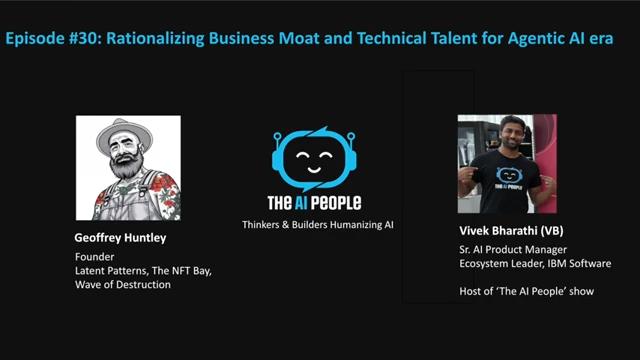
A couple of days ago, I sat down with Vivek Bharathi and dumped my brains. Here's the interview...
By Geoffrey Huntley in AI — 13 Mar 2026
0:00
/11:14
Below you'll find an AI transcription of everything we riffed about.
Key distinction: Software Development vs. Software Engineering:
- Software development (typing code, prompting LLMs) is accelerating massively and becoming ubiquitous—anyone (e.g., a hairdresser using Cursor) can now be a "developer" due to abundant AI knowledge/tools.\
- Software engineering remains essential and is evolving: engineers now act like locomotive engineers — keeping the "train" on tracks by designing safe, reliable systems/automations rather than working "in" the business (manual coding).\
- Shift focus to designing loops, automations, safety mechanisms (e.g., sandboxing, credential management, security), risk engineering, and responsible AI utilization.
Implications for professionals:#
- If your identity is tied to being a traditional "software developer" (keyboard typing), it's a tough time—prompting for outcomes is the new norm.
- If your employer bans AI tools, leave immediately: it's business suicide to ignore AI, while staying risks employability suicide as the market for manual coders shrinks rapidly.
- Engineers should prioritize raw technical/cognitive skills → engineer away concerns (e.g., replace binary code reviews with risk-based approaches, feature flags, constrained blast radius, auto-migrations).
Open source is "dead" (or greatly diminished):#
- Traditional open-source libraries existed to ease hiring and sharing reusable code.
- Now, with AI generation, there's little point: generating code avoids maintainer burnout, GitHub issue delays, abandoned projects, supply-chain attacks (e.g., npm takeovers), and Dependabot update toil.
- Better to generate first-party code for faster evolution, full control, and no human "tool calls" (which disqualifies true AGI-like autonomy).
- Exceptions: highly sensitive areas like PKI/SSL where generation isn't appropriate.
Broader industry shifts in an abundance era:#
- Software moves from scarcity (differentiated libraries, hard-to-replicate tech) to abundance (easy generation/reimplementation).\
- Many software products become hyper-commodity (like utilities: electricity, web hosting) — easily screenshot + reimplemented via AI (e.g., Claude).
Vendor lock-in and switching costs vanish (e.g., auto-migrating databases/apps).#
- True moats now lie in non-technical areas: contracts, relationships, handshakes, stakes, distribution, taste/judgment — the "hard things of business."
- Unit economics of software have fundamentally changed → questions if software remains investable (VCs unsure about moats, fundraising challenges).
Future: hyper-personalized software; old models of building/scaling via scarcity are disrupted.
Closing advice#
- Stay relevant by running fast, staying curious, and adapting to the "brave new world."
ps. this interview is also available:
- on youtube at https://www.youtube.com/watch?v=SMVyUu-GTpU
- X - https://x.com/GeoffreyHuntley/status/2032163849067987280
- LinkedIn - https://www.linkedin.com/posts/geoffreyhuntley_a-couple-of-days-ago-i-sat-down-with-vivek-activity-7437931906714791938-4_75
p.p.s don't miss out on free lifetime access#
Join thousands getting premium insights delivered weekly. Subscribe now and you'll never pay - even when I start charging new subscribers. This free-for-life offer won't last forever.